An analysis of contemporary mechanisms of social control from the national to the local level. How 'cyclists vs. drivers' conflicts serve to divert attention from real urban and development problems.
Table of Contents
We live in interesting times, when conspiracy theories are flourishing like never before, and our country is particularly fertile ground. What interests me most is the fact that they are not the domain of only “church-going patriots”. Paradoxically, equally tasty morsels can be found among those who call themselves progressive, endowed with critical thinking and open to other views. The perfect example here is the thesis percolated by the Civic Platform environment that PiS acolytes will falsify the election results or block the transfer of power after a lost election. Sound familiar? It is an almost mirror image of the MAGA narrative about “stolen elections”.
Meta-narratives and polarization: the subtle art of keeping a tight rein
But the real mastery lies in meta-theories. On the one hand, we have the belief that PiS is a project planned in Yasenevo or even in the Kremlin. On the other, an equally established belief that liberal circles in Poland are the work of Soros, and Donald Tusk is a German agent. I have often heard someone recently say under their breath that this is all the work of Soros.
The purpose of all these stories, myths structuring a chaotic world, is one: to keep the electorate in check and to polarize society to such an extent that any substantive discussion becomes impossible. It is a classic control mechanism that diverts attention from real problems.
As soon as a shadow of normality appears on the horizon, substitute topics are pulled out as if by magic: war, abortion, LGBT, spies or any other scarecrow or scandal of the day. Meanwhile, everyone misses the fact that we live in a country made of cardboard. It is much more convenient to get excited about ideological wars than to deal with real problems, such as the garbage mafia or development pathology, which destroy or steal our common good without hindrance. The spreading urban chaos will mark our neighborhoods for generations. And this pouring concrete is not a conspiracy of leftists, Yasenevo or Soros…
Cyclists vs. Drivers - how polarization is set up at the city level
Let’s look at the most elementary level, at local problems.
At the local level, this mechanism is perfectly illustrated by the constant fueling of the “drivers versus cyclists” conflict. Observing urban activism for several years, I have come to the conclusion that this is a special strategy. You see, the problems of bad city management are discharged by building an access road or a bicycle ramp or path.
Yes, and this dream bike path will be created so that you can leave your patho-estate to your corporation. And in the meantime, the city will be built up to the brim with developer behemoths. When protests appear, the topic will be appropriately directed to throw cyclists another scrap, and maybe for drivers instead of a potholed dirt road, out of pity, a paved road? And so it goes.
Look, cyclists themselves often contribute, becoming whipping boys. Instead of factually pointing out urban chaos, they stomp their feet, demanding absurd solutions, such as a bicycle ramp or a closed street. It’s like putting a plaster on an open, mortal wound in urban chaos. In this way, it is very easy to ridicule them, to make them a tool in a game that is supposed to divert attention from the real decision-makers and their negligence. In the end, they will get that ramp, but the topic will be dragged out a bit to show the goodwill of the Lord, the city, or the developer building the sidewalk.
It seems to me that “Drivers” do not see that the effect of traffic jams, lack of parking spaces, is not a conspiracy of ecologists, leftists, but bad city management, bad urban planning. Creating housing estates where developers, with the city’s consent, cram in new housing estates, increasing the number of inhabitants several times over. The infrastructure and existing public utility facilities do not provide for this.
In Łódź, we have a Facebook profile that is often quoted by TVN24 and other media, it is the right-wing ŁÓDŹ ZMOTORYZOWANI. They did a great campaign of postering and banners against Zdanowska. However, their profile is full of AI-generated content about stories of cycling-freaks, or writing about the ideas of ecologists, this is what this whole game of appearances is about. The point is for cyclists and drivers to beat each other up on social media. For normals to click likes. Łódź Zmotoryzowani does not harm the system at all, but is an excellent element in the puzzle of polarization.
Participatory budget as a release of tension
When things get really bad, the participatory budget becomes the ideal tool. A little money is thrown in and people are told: “Here you are, here are the funds that you can dispose of in a democratic way. Of course, before we approve the projects, they will be moderated, and then voted on”. We haven’t built you a bus stop by the school for 20 years? So now, to teach you democracy and money management (we do it in the sweat of our brow, listen!), you have a unique opportunity to cast your vote.
Those who criticize participatory budgets supposedly do not understand the idea of social participation in co-governing the city. And the truth is that this tool is primarily intended to release tension and occupy buzzing heads with dilemmas: whether to choose a bicycle ramp, a notice board for residents, or maybe a bus stop shelter that has been missing for decades.
What are developers and local politicians really afraid of?
They are afraid of the combination of protests and showing their incompetence. That is why the authorities’ newspapers (these are the media managed by local governments in which the fiction about the excellent effects of their management is pumped, not to mention that there is blatant advertising for developers) become a key tool of manipulation.
As reported by Watchdog Polska, already in 2018, over 832 municipalities in Poland had their own newspapers. These are not neutral information bulletins, but propaganda tools that “built a positive image of the municipality’s situation and the role played by local authorities”. People participating in Watchdog’s training on information transparency for local government officials could see concrete examples - in most of these newspapers, difficult topics were missing, and the opposition had a voice in almost only one of the 67 publications analyzed.
What’s more, this practice may be illegal. As the Helsinki Foundation for Human Rights points out in a petition to the Ombudsman, local governments can only conduct “advisory, promotional, educational and publishing activities for the benefit of local government” - nowhere in the law is there any mention of publishing a press. However, in practice, the line between a permissible newsletter and a prohibited newspaper is often deliberately blurred.
These newspapers are not only a competitive problem for independent local media. They are a powerful tool for narrative control that allows the authorities to shape local reality according to their own scenario.
Fragmentation and control, can you go beyond the algorithm?
Contemporary society lives in a strange illusion of freedom. We have “freedom from” - from boredom (Netflix, TikTok), from loneliness (social media), from ignorance (Google)… but do we really have “freedom to”? Freedom to have a real impact on the city? To authentic participation in the decisions that concern us? Go beyond the algorithm.
Urban activists and protest organizers are to engage in these individual, parceled out flashpoints. They are to devote time to this, burn out, but God forbid, they cannot connect these environments, show common problems or implement a common agenda. If only such an idea appears, a radically extreme person is immediately triggered from this environment, who latches onto the narrative and causes the whole thing to be reduced to absurdity from the outside. Look at the effectiveness of these environments, some have been active for over a dozen years in NGOs or local government politics and strangely the city continues to degrade. Strange, right?
People think that power lies in the ability to choose a participatory budget project, to like something on social media on the profile of activists or councilors, or to repost content. It is their small, cheap voice - the illusion of “freedom to” act. Meanwhile, the real decisions are made somewhere completely different, in a way that is incomprehensible to the average person.
These are not conspiracy theories. This is pure business. 21st century feudalism, where access to entertainment has replaced access to real control over our living environment. Recognizing these mechanisms is the first step to any real change.
What are the limits of your tolerance for criticism?
I am asking you here about your limits, how resilient you are, how far you are able to go? Contemporary progressivism has its own specific ailment. Hipsters sitting in club-cafes have their limits… right-wing, liberal, left-wing bubbles have their selective perception. Critical thinking is valued, yes, but only up to a certain point. Nobody wants to listen or read about how bad things really are if it strikes at the foundations of their worldview or comfort. Especially when he has moved into a house with a 30-year mortgage, his problems are focused on driving his child to kindergarten or school in traffic jams and commuting to the corporation.
That is why developers who coexist in a perfect arrangement with local government officials (I refer to the analysis of Patodeweloperka by Bartosz Józefiak), can sleep peacefully. Nothing will change here, because a deeper criticism of the system is inconvenient for too many. To relieve a bad mood, let’s make a transfer to the Last Generation, let’s walk a dog at the shelter (of course, describing it on social media), let’s repost a post mocking ecologists (if we laugh at the green deal and cycling).
The real decisions are made somewhere else. Your entertainment subscriptions and the whole culture of self-satisfaction, behavioral triggering you on social media - all this is tailored so as not to touch the heart of the problem. Or maybe it’s time for a critical thinking subscription? It only hurts for a moment. Later you breathe clean air without the stench of posturing and lies. How resilient are you?
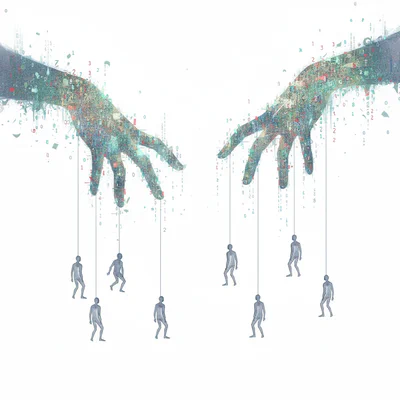
DISCLAIMER: Text illustration
Today’s picture is by B, who created it at the request of Łódź activists as a criticism of the event city that Łódź has become and as a protest against the implementation of the Audioriver electronic music festival in the Na Zdrowiu Park, a decision that was issued (according to my knowledge and activists’ reports) in violation of local plans and against the will of the residents.
Of course, in the end, Zdanowska withdrew from the decision, moving the festival to the outskirts, announcing the success and the decision as an element of listening to the needs of the residents. At the same time, trolls of local government politicians accused (in the form of profiles of local politicians) that it was the activists who chose such locations (well, there were no consultations). This is how the narrative is managed.
What is the problem in the context of this picture and the whole affair, and what the street does not get? The fact that the city got rid of all the plots that could be spaces for mass events in favor of developers and wanting to implement the idea of an event city, they came up with the idea of renting a historic city park to a private company from Warsaw for a mass event.
Thank you for sending the graphic and allowing it to be published. As I understand the authors, it is an element of criticism and this visual commentary on the described mechanisms should be considered as such.