The dark side of rapidly developing cities and urban planning: how developer interests and apparent activism create the illusion of choice in urban planning.
Table of Contents
In today’s post, I will present observations regarding spatial planning processes, property development, and the pathologies associated with them. This is the opening post of a whole series, describing in fragments the sad reality of Łódź. Since 2019, I have been observing a process that I think can best be described as the blocking of Local Spatial Development Plans (MPZP) in Łódź, a city that boasts one of the lowest percentages of area covered by MPZPs, but is the most friendly to developers (the fastest production of zoning decisions and the fewest problems with issuing decisions for investors). This is an excellent way to pump up the development industry, where the main focus is on maximizing profit from a plot of land, not the development of a neighborhood. The problems are passed on to the residents.
Urban Chaos in Łódź – a Paradise for Developers, a Hell for Residents
The scale of protests in Łódź is colossal. It’s not just people who want to introduce an MPZP, fearing uncontrolled construction of apartment blocks, waste sorting plants, or ribbon development, who are protesting. Neighborhoods are being built without roads, without shops, with single-family houses built up to the horizon. Owners of agricultural land being converted to building land are also protesting. The latter would be most happy to join the gold rush. Unfortunately, as is usually the case, they lack connections… so they will end up with nothing, and those who are meant to build will build to the max.
Today we will touch upon the mechanisms that I may have interpreted correctly, having insight into the processes surrounding the MPZP, Neighborhood Councils, the City Council, and the Municipal Urban Planning Studio. Which, even observing from the outside, looks very interesting. Many of these processes were described by Józefiak in the book I’m referencing here.
False Dichotomy – How Are We Being Fooled?
What is this game of false choices in spatial planning all about? Let’s look at a classic scenario that could be a user manual for developers and their minions, of which there are many:
Option A: Developer Freestyle - A developer who wants to build in a place without an MPZP presents option A: multi-family housing based on a zoning decision. The development has no relation to the surrounding area, which is mostly single-family houses. The implementation of an MPZP for this area temporarily blocked the developer’s zoning decision.
Option B: The Municipal Urban Planning Studio Enters the Game - The MPU, which previously issued zoning decisions automatically for every investment, now that we are proceeding with an MPZP, proposes option B during public consultations: “urbanistically optimized” terraced housing on micro-plots instead of controversial blocks. At first glance, it is a different project, because indeed, instead of blocks, we have micro-houses on 200-meter plots with a garden where you can put a chair and maybe a barbecue.
PUM (Usable Residential Area) – The King of Manipulation - However, after a closer look and comparison of the two options, we see that the key element, i.e., the profit, is potentially the same, because both options generate an identical PUM (Usable Residential Area - the final area of apartments for sale), differing only in the form of development. That’s why the plots are not 500-600 meters with one house, because the block, which had X residents and Y PUM, which equals profit, is simply distributed differently. It comes out almost the same.
For those who are not familiar, it is worth explaining - PUM is the most important indicator for investors, determining how many square meters of apartments can be “squeezed” out of a plot. It does not include common areas such as corridors or staircases - only the net sales area counts. And it is this indicator that remains identical in both presented options.
We’re Densifying, Densifying to the Max!
I will add that my plot is 660 meters, and other plots in the area are even 1000-2000 meters, and at the time of building houses, private investors were told that the neighborhood was heading towards such residential development. Well, they are being brutally brought down to earth. The development will be densified. From my observations, it appears that for the local government, the priority is rather the income from property tax and taxes paid by new residents, than the problems or needs of the current residents… we will also not develop the issue of potential personal connections with developers. It is said in Łódź that there have even been reports to the prosecutor’s office. But will the lord ruling over the serfs allow a trial in his own case?
There is also a visible process of diluting the current protests by increasing the number of residents, which in the long run will also increase budget revenues. The problems of existing neighborhoods often take a back seat, and their solution is postponed to future, uncertain investments. The key problem is that it is difficult to reverse the negative effects of excessive densification - infrastructural shortcomings, insufficient public transport, or lack of basic services lead to a gradual degradation of the quality of life in the neighborhoods.

How is the “Better” Option Promoted? How is the Issue Guarded?
This is a real circus, perfectly described in the book Patodeweloperka. To nie jest kraj do mieszkania by Bartosz Józefiak. “Independent experts” and “concerned residents” are brought into the game to support the “better” option, saying that these overgrown plots look bad, that we need to build. Helpers appear, asking for urgent contact and extracting as much information as possible.
The problem is that if you trace the connections (I traced them through the National Court Register and OSINT, I have a whole map of potential and interesting connections, I did it for sport, I’m not doing anything with it), I think in some cases you can see social relationships (Józefiak wrote about it). Someone is the wife of a developer, someone plays the role of a concerned activist and a friend of the trees, someone is in the Neighborhood Council and strangely there has been a problem with implementing the MPZP for 5 years, but if you look at it critically, they are there only to guard the issue… Someone off-record says that a few neighbors here go skiing with the investor, and they themselves admit to owning several investment plots. The pattern of actions is probably similar everywhere - someone was too active in the City Council and got a lucrative position, someone wrote in the local media and also got a position… and so on.
Opponents of both solutions are presented as radicals blocking development. This also discourages sensible people from taking action. How many times have I heard: I support you, but you understand that this director from the City Hall is my friend, I can’t expose myself too much. A wide-ranging disinformation and slander campaign is underway against people who draw attention to the fact that a neighborhood with poor infrastructure, a small school, and a small number of shops cannot suddenly accommodate 3 times more residents, because we are talking about such a scale with the development of all plots.
The Stench of Event-driven Pseudo-activism Spreads Through the City
It is also worth adding that by granting a building permit as described above, we open the door to possible further construction in a similar manner. The MPZP is a document that can be bypassed by the Lex Developer, where the City Council (some claim that there are people there who do not accidentally occupy their positions… I will not elaborate on this, because public discussions in the form of interpellations or endless discussions on Facebook often take the form of superficial activism) votes through the appropriate options without deeper discussion. Comments submitted to the MPZP and forwarded for voting by the City Council are also subject to a fast-track procedure. Characteristically, residents’ comments are usually rejected, while investors’ proposals are accepted.
This leads to a fundamental question - in whose interest does an institution theoretically established to protect spatial order act, by proposing solutions so surprisingly convergent with the developer’s interest? I ask as a concerned citizen, resident, and taxpayer.
A Shell Game on a Grand Scale?
And here we come to the heart of the matter - doesn’t this situation resemble the classic shell game? We have a seemingly fair choice, we have “independent” observers (read: local politicians and “concerned” activists) who convince us of the sense of one of the options. There are even “lucky ones” who managed to “choose the better option”. No one has seen them, but apparently they exist…
The problem is that - just like in a shell game - the result is a foregone conclusion. Regardless of which “shell” we choose (multi-family or terraced housing), the effect will be exactly as the organizers of this game planned. Maximum building intensity, maximum profit. Densification of development to the max and maximum investor satisfaction.
The question therefore arises - does it make sense to participate in a game where the winner is predetermined? Or maybe instead of choosing between two variants of the same solution, we should completely change the rules of this game? Because maybe that’s the point - that we discuss the choice between option A and B for so long that we forget about the existence of the entire alphabet of other possibilities? I do not currently see people ready to take the actions that would need to be taken to really harm such mechanisms, or at least to expose them.
I have an impression bordering on certainty that local politicians are not for the residents, but for the development industry. Activists allegedly creating grassroots actions are actually part of the game, a decoration intended to distract residents from real protest so that the business can go through. Where there are no regulations, the most money is made, and the victims of urban chaos are the residents.
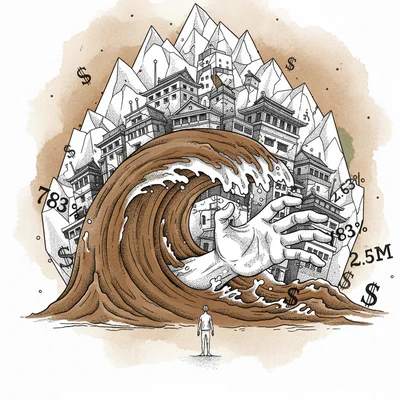
DISCLAIMER: In writing this text, I relied mainly on reports from Facebook regarding reports to the prosecutor’s office, reports from local media, as well as Józefiak’s book. I am not aware of any corrupt connections, nor do I have any information about illegal decisions by officials. The text is an expression of my personal observations and thoughts on spatial planning processes, and all cited situations should be treated as examples of mechanisms, not accusations against specific people. The illustration was generated by artificial intelligence based on the analysis of the article. It is a metaphor for unclear mechanisms.