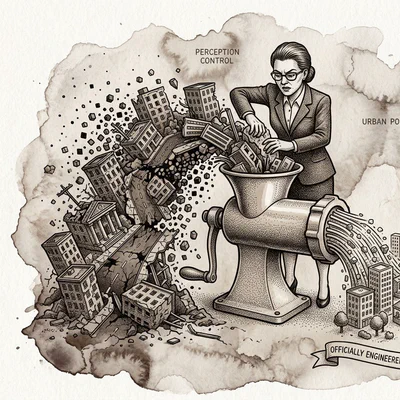
A subjective op-ed on the curse of excess: why a hundred freedom-of-information requests and empty interpellations are no substitute for strategy — and how AI turns real pressure into an event-driven theatre of appearances.
Table of Contents
Disclaimer: I write this as someone who himself keeps a close eye on the activities of activists and NGOs in Łódź. My point is not to discourage civic activity, but to draw attention to a certain mechanism: many actions that look like pressure in fact serve as a safety valve — they release tension and generate visibility, but never touch the actual decision-making machinery.
I have no wish to discourage hot heads by criticising activism as such. I simply have a warped, businesslike disposition — results are what count. Of course I appreciate the networking and mobilising dimension of some efforts. Some readers will remember my analysis of the parliamentary interpellation on the ActivityPub protocol (an interpelacja is a formal written question that an elected representative — here, a member of the Sejm, the Polish parliament — submits to the executive, which is legally obliged to respond within a set deadline). I showed back then that an interpellation done “for art’s sake,” with no risk analysis and no grounding in reality, is hollow. Today no one remembers the interpellation, let alone my very committed critical analysis of it.
Interpellations With No Sequel
I genuinely fail to understand what effect an interpellation is supposed to produce when it has no finale. From what I observe, a great many such actions serve above all to harvest likes from a bubble of followers, who in the comments fantasise about how much this interpellation “will achieve” and “how it will change the system”… or, more often, simply “wow, he/she really stuck it to them.”
The second problem is that ordinary people are by now completely numb to yet another post about broken pavements, tree plantings or GDPR. Each new interpellation and petition drowns in the noise. Who in their right mind, outside the bubble, would want to wade into this? Faced with this flood of filings, the average citizen comes away with the impression that the office “responds efficiently,” while the fact that it stays silent on the things that actually matter escapes them entirely. Nor can they easily judge whether that silence stems from something being hidden, or simply from the office being physically clogged by a tsunami of ill-considered requests.
So it is worth asking: why are we really digging into this? Often, if we are honest with ourselves, what stands behind it is a great big NOTHING. Or something worse — our own self-satisfaction.
We Have Seemingly Important Information. The Office Answers in Quantity but Rations Quality
Łódź is a good example. In 2025, councillors filed 515 interpellations there. The City Hall reported with satisfaction that it had answered 513 of them, 400 of those within the statutory deadline. Lovely figures — I quote them after the local edition of Gazeta Wyborcza.
In practice, however, councillors complain of systematic obstruction of access to information. Kosma Nykiel (an unaffiliated member of the Łódź city council), among other things, asked about the timetable for relocating the magistrate’s departments to the new seat on Wólczańska Street. In reply, the city secretary Wojciech Rosicki (a senior municipal official appointed to run the City Hall’s internal administration) wrote that “matters relating to the internal organisation, structure and spatial logistics of the office (…) are the domain and exclusive competence of the executive body,” and advised the councillor “to refrain from directing further inquiries in this area.”
A similar fate met an attempt to inspect documents concerning the investment in the Łagiewniki Forest — Nykiel was refused access on the spot and given an appointment “in a few days’ time.” The councillor commented bluntly:
“Pulling documents out of a binder in a cabinet takes a minute and a half at most. Sending a ready-made set of documents by email takes maybe five minutes. It is hard to trust assurances of good intentions regarding this investment if a councillor has trouble accessing the very basis for exercising his mandate.”
Source: Alicja Zboińska, “Urząd Miasta Łodzi w trybie top secret. Czym nie powinni się interesować Łodzianie”, Wyborcza.pl, 23 June 2026.
In the same city, councillors file interpellations about mowing the grass on a disc-golf course, trimming shrubs, or installing benches at bus stops. So the city can, on one hand, boast a high response rate, and on the other, effectively limit any real oversight of the more important matters. The statistic functions here as a shield: the more filings, the easier it is to prove “we are transparent,” even if, in practice, access to information is rationed.
When the FOI Request Becomes a Weapon, Not a Key
The mechanism for accessing public information — in Poland, the dostęp do informacji publicznej, or DIP, the country’s freedom-of-information request, governed by the 2001 Act on Access to Public Information and broadly equivalent to a FOIA request in the US or an FOI request in the UK — is, in theory, a citizen’s tool. In practice, the way it is used has already reached caricatural forms. At one watchdog training session I heard an open discussion that DIPs increasingly serve to harass officials and generate nuisance, rather than to actually obtain information.
I recently saw a request in which, in my assessment, the sensible, substantive questions made up maybe 10%. The rest was elaborate tabulations and constructions of absurd complexity. Unfortunately, on social media it is precisely such bloated forms that win the most applause, even though their real effectiveness is negligible.
The DIP, in My View, Is Fetishised! A Prop in the Theatre of Appearances
Genuinely valuable information today is so well hidden and so dispersed that extracting it with an FOI request alone is often impossible, or deliberately slow-walked. Anyone who truly knows what they are looking for also knows that, in serious matters, DIPs act as an early-warning alarm for the other side. One can always respond formally while saying nothing of substance. The case of the Public-Private Partnership and of the Łódź Tourism Organisation (ŁOT — a municipally linked body running the city’s tourism promotion) is one example — an entity that remains beyond any real oversight.
Reading the replies to interpellations and DIPs, I have the impression of a theatre of appearances. The petitioner receives a pseudo-answer, posts it on Facebook, and for a week there is laughter or outrage — and that’s the end of it. And what comes of it? Some notification to the prosecutor’s office, or to another institution?
The point is not to abandon DIPs altogether. The point is to stop treating them as a universal and sufficient tool.
It is worth noting, too, that in many cases speaking of “officials” and “official decisions” is already an oversimplification. Increasingly, the people who formally hold posts in offices or municipal companies are not classic civil servants. They are often businessmen who, in one way or another, have a stake in the very interests regulated by the entities they manage or influence. Their conduct is governed by a typically corporate logic, which is hard to reconcile with the ethos of transparency and public service.
For them, a presence in public structures is often merely a way of exercising control over a given slice of the market. At the decisive moments, what speaks through them is business logic — profitability, business risk, “the company’s interest” — not the ethos of public service.
The question is: how do you extract a key piece of strategic information from someone who treats every such inquiry as a hostile move on the market? These people sleep soundly, because the scale of matters is so vast that establishing the actual decision-making mechanism lies beyond the reach of the average activist or councillor.
Reader, I am not condemning the bringing of information into the light of day. I am not criticising DIPs. All of it makes sense as long as it leads somewhere. Openness for its own sake is pointless if we do nothing further with the information. Openness without usefulness is just one more ritual.
Generative Action, or Intelligence Without Intelligence
DIPs, complaints and interpellations on a mass scale would not be produced at this pace were it not for the capabilities of generative artificial intelligence. The person dumping stacks of articles and Facebook posts will always find a new target for criticism, yet, strangely enough, rarely reaches the mechanism that gave rise to the problem in the first place. Perhaps this is a limitation of intelligence — though not the artificial kind.
In my view, fetishising DIPs and interpellations delivers, above all, the illusion of action. Likes, reports, “I filed an interpellation,” “I filed a DIP.” Real pressure and real change demand something else: strategy, follow-up, and a readiness to put information to use — often in silence. It may even, against the very idea of openness, demand a measure of cunning.
OSINT, paired with genuine assessment of information, gets you further from the outset. If we frame an investigative hypothesis and, in line with the craft of information assessment, keep drilling into the subject, we will quickly map out the next vectors. But if we leave such a thread without continuation, then even a hundred more DIPs will yield nothing. I have seen replies to interpellations on seemingly trivial subjects that contained, implicitly, further vectors of analysis — left unused, of course.
I use artificial intelligence every day, in my work and for critical analysis. Yet 100% of the investigative idea comes from my own head, not from a machine that reinforces cognitive biases. I observe that more and more people throw problems into a language model without knowing its limits and without a sound methodology. Instead of analysing the matter themselves and building a strategy, they generate ready-made filings and post the results on Facebook. The AI suggests off-the-shelf paths: “this calls for that kind of complaint,” “here, a complaint to all the saints,” “write the interpellation in this form.” The result is a tsunami of generic, poorly considered filings. Offices that already operate at the edge of capacity are swamped by a wave of cases with no real concept of what comes next. AI is an excellent instrument for mass document analysis and for stress-testing one’s own conclusions — not for fairy-tale writing.
The effect? Instead of precise, strategic pressure, we get noise. Instead of singling out the matters that truly count — paralysis by volume.
This is merely one more symptom of the same pathology: fetishising formal instruments while neglecting what matters most — thinking about results, and patient, often quiet work.
You will know them by their fruits. What I criticise is not the tool, but the atrophy of thought and action — the belief that merely filing a request or an interpellation is already a success. Sophistry is a terrible disease.