Signal Dadalo Media has received funding from the Civic Fund to develop urban monitoring tools in Łódź. The grant will support the expansion of Watcher and the creation of an open database for local protests, tackling information asymmetry between citizens and authorities.
Local authorities are often linked to business interests, and time pressure combined with informal arrangements deepens the information asymmetry between residents and interest groups. I want to change that.
I reached this diagnosis a few years ago when I started tracking Łódź’s planning procedures. The mechanism is simple: residents usually find out about changes to local spatial development plans (MPZP) after the consultation deadline. To make it in time, you’d have to check the city’s website every day—and even then, it’s often too late to take any action.
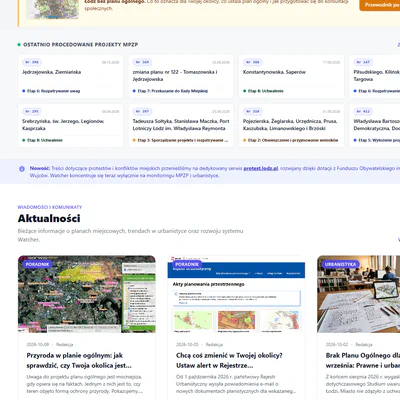
This is how Watcher was born—a system that tracks the Public Information Bulletin of the Miejska Pracownia Urbanistyczna (MPU) and provides real-time notifications via ActivityPub (Fediverse), RSS feeds, and an online dashboard. I have been building it over the last three years in my spare time, using my own funds without any grants, as the editor-in-chief of my newsroom, Signal Dadalo Media (I wrote more about the system’s origins in the article: Watcher: A Watchdog System for Urban Planning in Łódź).
Today, I have good news: the project has received funding from the Ludwika and Henryk Wujec Civic Fund (Fundacja dla Polski)—taking 3rd place in the “Pilnujemy. Robimy różnicę" (We Watch. We Make a Difference) competition.
The funding will primarily allow us to fix existing shortcomings, finally separate the Watcher and Protest projects, and significantly accelerate their development. The grant will support the development of two tools:
→ watcher.dadalo.pl — real-time monitoring of MPZP procedures: anomaly detection and archiving of consecutive document versions.
→ protest.lodz.pl — an open database of protests in Łódź. This second platform solves a specific problem: your neighborhood is protesting, the neighboring one is too, but neither knows about the other. Dispersed protests are easier to ignore—collected in one place, they are harder to dismiss. Wherever a protest has an urban planning basis, we will link it to the corresponding procedure in Watcher.
“Your neighborhood is protesting. The neighboring one is too. Only nobody knows. We are changing that.” “Protests in one place. Because dispersed ones are easier to ignore.”
The activity remains non-profit. I thank the commission for their trust. Now, back to work.
The initiative is supported by the Ludwika and Henryk Wujec Civic Fund.