Meet MPU Watcher – a proprietary monitoring system for planning processes in Łódź, created to combat information asymmetry and the architecture of exclusion in urban planning.
Table of Contents
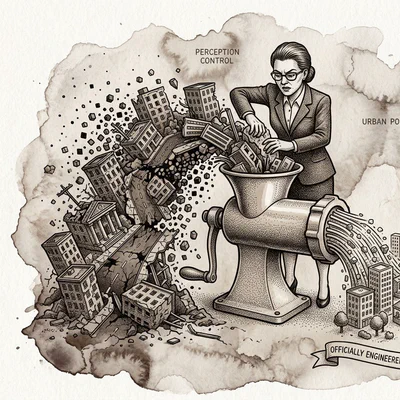
In May 2025, I published an analysis titled “Silent Proceeding of MPZP — Information Asymmetry as a Systemic Problem", in which I argue that the way citizens are informed about changes to Local Spatial Development Plans (MPZP) in Łódź bears the hallmarks of a systemic violation of the right to information. I have the impression that the existence of this information asymmetry is the primary cause of social tensions that I try to map on the conflict map. BIP announcements, notices in newspapers that no one reads, consultation dates falling during the holidays… sometimes it’s hard to believe these are accidents. Sometimes, based on investigative journalists’ publications, one can have the impression that the way of proceeding and informing is specifically designed this way. Is it a deliberate architecture of information exclusion, in which the city hall and appropriately informed groups have a full picture of spatial changes, while residents find out about them the moment the excavators move in?
This article is not another diagnosis. It is a description of a specific response.
What is MPU Watcher?
MPU Watcher (available at watcher.dadalo.pl) is an independent, two-module system for monitoring planning processes in Łódź, which I have been designing and developing as part of Signal Dadalo Media for over three years. What is available on the watcher.dadalo.pl domain is the presentation layer. The data, however, has been collected for years. Systematically archived and available for analysis. The system operates continuously, automatically scanning official sources of the City Urban Planning Studio (MPU), detecting changes in MPZP procedures, and archiving documents before they are removed from public registers.
The platform consists of two main components:
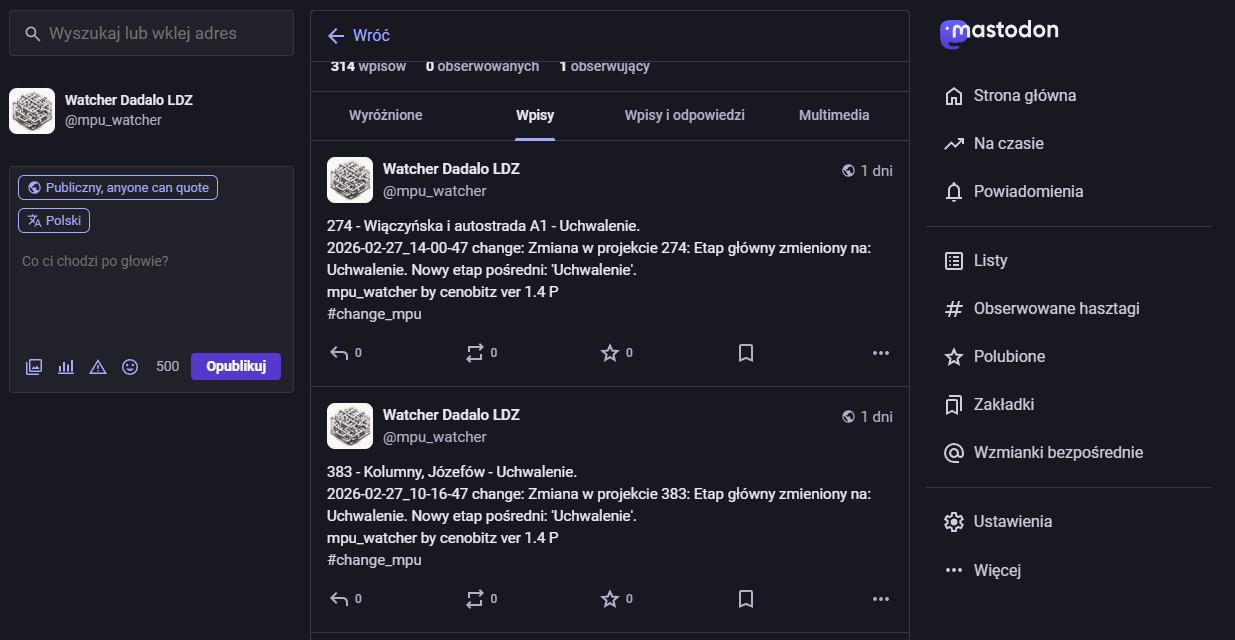
Monitoring engine — a set of scripts on servers that regularly index MPU pages and track plan movements between nine stages of the legal procedure. Each change is logged, dated, and saved in a structured JSON database. The system does not rely on officials’ goodwill regarding information; it actively seeks changes. When detected, the system automatically sends notifications to the Mastodon network (ActivityPub protocol). This allows anyone to receive free and instant alerts about new plan displays directly on their phone or computer.
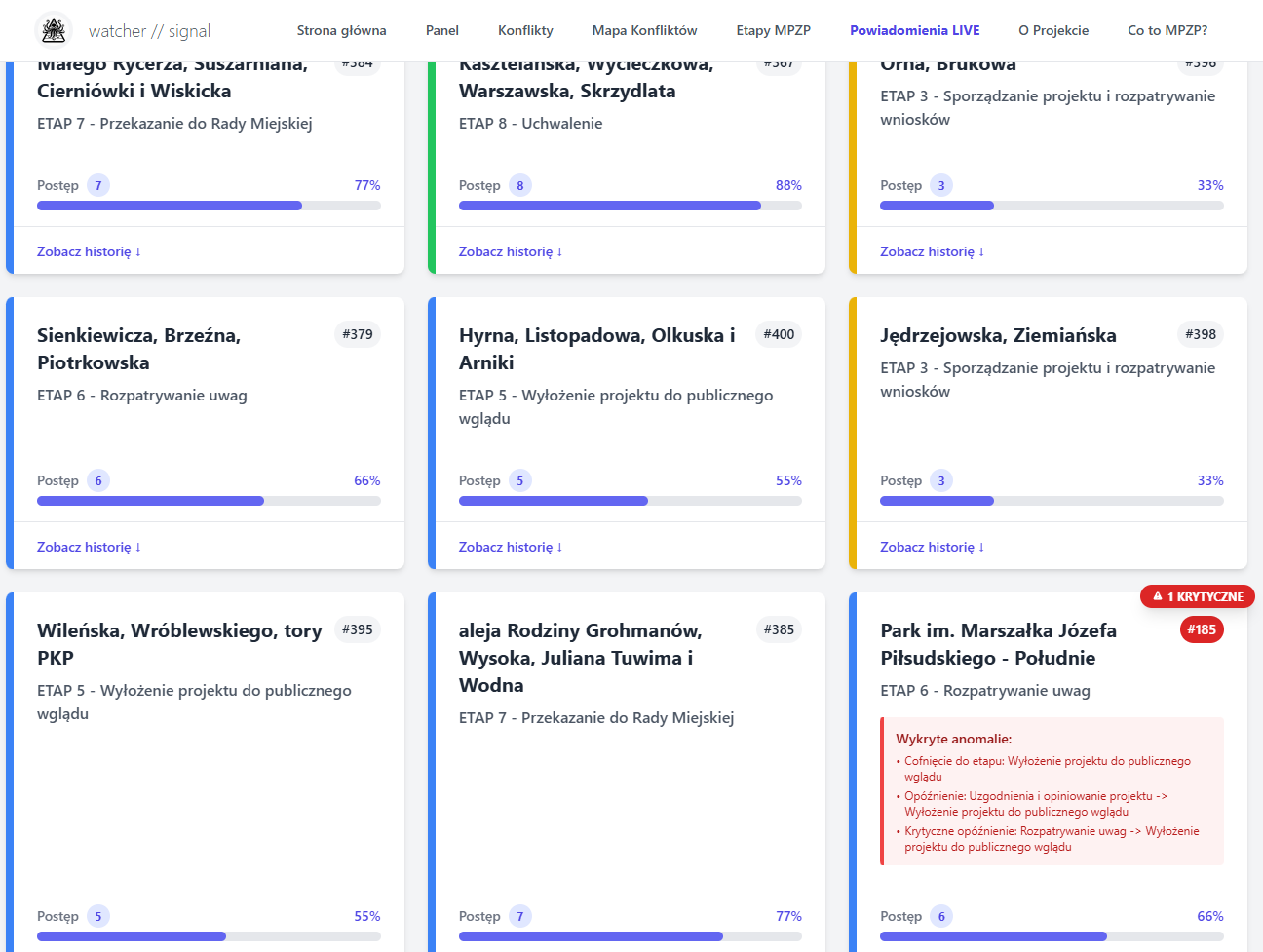
Analytical portal — the presentation layer, where we consume data provided by analytical and scanning mechanisms. Raw data from scrapers is processed into useful knowledge. The monitoring panel visualizes the status of each MPZP project.
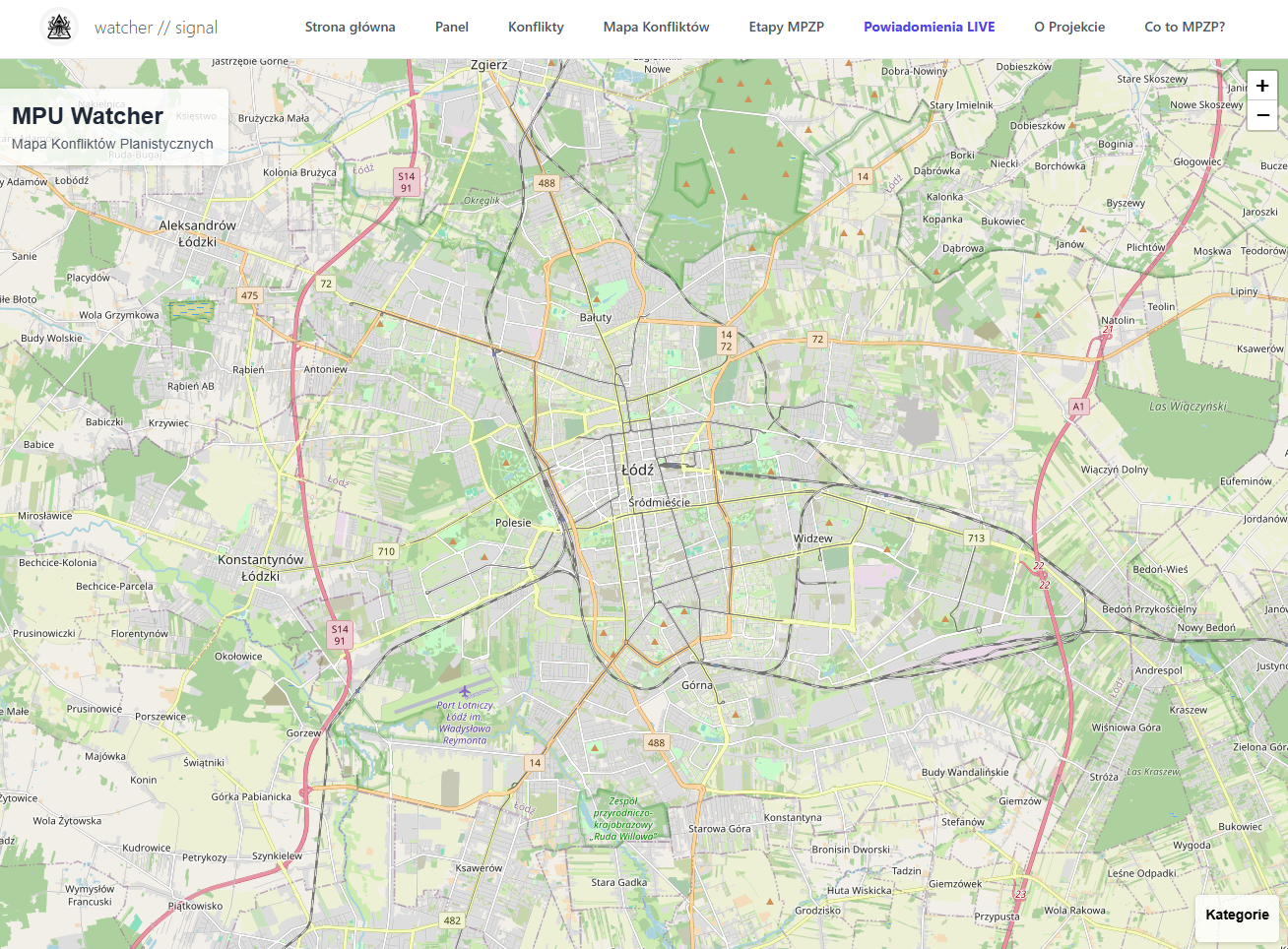
Additionally, the system builds a knowledge base regarding spatial conflicts in Łódź. An interactive map plots flashpoints on the city plan, documenting urban controversies. Over time, this data will create an authoritative archive of social conflicts in our city, allowing for the analysis of trends and recurring mechanisms in Łódź’s urban planning.
Three pillars that distinguish Watcher from a regular dashboard
1. Independent archive: memory that the office cannot erase
Offices often remove parts of the documentation from the MPU information website (which does not hold BIP status) immediately after a local plan becomes legally binding. As a result, key projects can disappear from the web exactly when they become effective law, drastically limiting the ability to verify building parameters. While official versioning is often unreliable, my system operates continuously—creating page snapshots and archiving every minor change. Access to information remains permanently open.
My archiving engine automatically downloads and “freezes” page snapshots, PDF attachments, and maps at the moment of their publication. I use my own, self-hosted ArchiveBox instance as a third independent and additional module. Thanks to this, I have independent proof of what was processed and when. In the form of a 1:1 page snapshot. In a system where institutional memory is controlled by one side, an independent archive becomes a tool that levels the playing field. ArchiveBox also serves in other investigations, providing full versioning of policies, regulations, pages, and news for practically every area of activity I monitor in my analyses.
2. Anomaly detection: a statistical guard of procedures
Option in testing phase
The system has the ability to analyze transition times between planning procedure stages, comparing them with historical averages. Based on this, it automatically flags:
- Critical delays — a project “stuck” significantly longer than the average (potential political blockage).
- Regressions — strange anomalies such as moving a project back to an earlier stage (a signal of legal flaws or intervention).
- Missing stages — “skipping” procedure steps.
Each detected anomaly is a signal for me to undertake journalistic verification. This approach allows me to focus time and resources on cases that statistically “stand out” from the norm.
3. Knowledge base on power mechanisms
The “Conflicts” section is a structured knowledge base documenting urban pathologies in Łódź. I document, among others:
- Investments in Lex Developer mode bypassing local plans.
- Patho-development and conflicts over urban greenery.
- Procedural errors and deliberate blurring of responsibility.
Information Asymmetry in the Shadow of the Pandemic: The Rogi Estate Case and Vice-Mayor Pustelnik
A perfect example of documented power mechanisms and information asymmetry is the case of the Local Plan in the Rogi Estate. Long after the COVID-19 pandemic state had expired, the office still invoked pandemic regulations to impose a limited, exclusively virtual form of consultation. This was a blow to the residents’ right to real participation, likely constituting a significant legal flaw in the entire proceeding.
In the official response to the petition of the Rogi Estate Defense Committee, Vice-Mayor Adam Pustelnik himself confirmed the use of this mechanism, writing explicitly: “despite the health minister lifting the epidemic state (…) art. 8i section 6 point 2 of the Act (…) on spatial planning and development enables conducting social consultations in the form used so far, i.e., using means of distance communication”. In the same letter, he simultaneously admitted that “few residents of the Estate use the aforementioned contact possibility”. Thus, the office knew that the adopted consultation format was ineffective, yet it decided to continue using it.
When the Committee pointed out these violations, the vice-mayor ignored the procedural charges, dismissing the inconvenient topic with a pacifying cliché: “In conclusion, I emphasize that the residents’ goals indicated in your letter are consistent with the goals set by the City. Local plans are intended to protect the existing character of the Estate (…)”.
It is such evidence of cutting off discussion and using the law that is permanently recorded in the system. An activist or councilor preparing for an urban planning commission will find ready precedents and arguments here. I try to ensure that the knowledge is supplemented with sources, i.e., links to press publications.
Early warning system: real-time notifications
Every change detected by the monitoring engine is immediately published on the @mpu_watcher profile in the decentralized Mastodon network, generating a push notification on the user’s phone. The lack of algorithmic filtering guarantees that the alert about a plan being put on display reaches the recipient directly.
Security infrastructure and private repository
The entire infrastructure — service, ArchiveBox instance, databases, and analytical tools — is hosted on my own dedicated servers. I do not use SaaS services that could be shut down, monetized, or subjected to external pressure. This is a conscious technological decision resulting from my experience and a conscious approach to editorial independence. Investigative data, archival snapshots of official pages, raw materials for analysis — all of this is on equipment over which I have full control. No one can “cut off my access” to my own archive.
The source code of the Watcher system is developed and maintained in a private repository on GitHub. Moving away from the public Open Source model was dictated by security requirements. Closing the code protects the scraper architecture from analysis by monitored institutions, secures system operation vectors, and prevents premature disclosure of development directions and other investigative tools integrated with the platform. Currently, I am developing four additional analytical modules based on advanced Open Source Intelligence (OSINT) methods, which will allow for even deeper verification of decision-making processes in the city.
Watcher is not the only tool
The MPU monitoring system is one of several tools that I actively develop and use in current investigative and analytical work. My ArchiveBox instance serves not only to archive planning documents but is intensively used in other investigations I conduct — from analyzing GDPR violations by public institutions to documenting disinformation mechanisms.
I am also developing tools for media monitoring, public data analysis, mass analysis of social network data, TikTok, YouTube. Some of them are in an active development phase and will be described in separate publications when they reach maturity allowing for their public release. I don’t treat technology as an end in itself. Every tool I build is a response to a specific problem, an information gap, a barrier to access public data, or an asymmetry that works against citizens.
Technology in this context serves to bridge the asymmetry. Information transparency is the foundation of resident safety, and access to data is real knowledge that allows for a partnership dialogue with the authorities instead of being presented with faits accomplis.
Modest possibilities, real effects
I am not backed by institutional budgets or grants. I have been operating since 2019 as an independent creator, combining engineering skills with journalistic work. Watcher is developed pro bono, fully funded from my own resources.
One guard portal will not change the systemic flaws of Polish urban planning, but it makes them visible. It shortens the reaction time of local communities from weeks to hours and provides hard data that the office will not be able to ignore. The system should inform citizens. If it doesn’t — I’ll do it for them.
Watcher is available at watcher.dadalo.pl
LIVE notifications of changes in MPZP procedures: watcher.dadalo.pl/powiadomienia
Urban conflict map: watcher.dadalo.pl/mapa-konfliktow
System architecture: watcher.dadalo.pl/system