Mayor Zdanowska publishes disgusting hate comments directed at her. The problem? She uses real abuse to build a protective umbrella against all criticism — from activists to questions about Jungle 360. How the well-poisoning mechanism works and why the absence of any trail at CERT/NASK raises questions.
Table of Contents
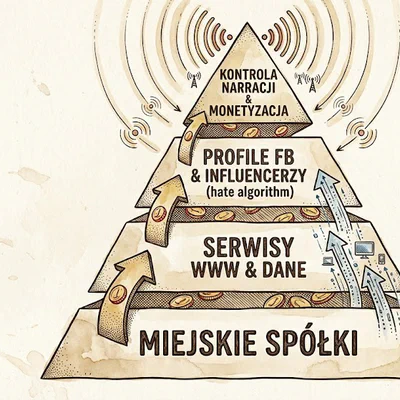
Municipal social media profiles are targeted by Russian propaganda and organized bot campaigns
Today I will analyze how politicians turn hate into a shield against criticism. A perfect example is Piotr Brzózka’s article “She Couldn’t Take It as a Human Being” (Gazeta Wyborcza, 17.03.2026). It presents a series of posts by Hanna Zdanowska complaining about trolls and the brutalization of online discourse. The comments she quotes are genuine and disgusting. But the mechanism that turns them into a protective umbrella… that’s a different story.
Hate as a Semantic Container
The key device in Hanna Zdanowska’s strategy is the creation of a container (a semantic container) into which vulgar insults and substantive dissent are deposited simultaneously. Zdanowska says:
“We are dealing today with an escalating brutalization of language, aggression, hate (…) On many topics, comments are flooded by bots, and some accounts are co-created by artificial intelligence”
Gutter-level insults and “deliberate manipulations” are equated as manifestations of the same phenomenon. The container for critics-cum-haters is ready.
Well-Poisoning: Technique and Application
Well-poisoning is an eristic technique that consists of preemptively discrediting the source of criticism before the criticism is even voiced. The effect is simple: every subsequent critical voice falls into a container already labeled “hate,” “bot,” or “Russian propaganda.” There is no need to address the charges — it is enough to question the critic’s motives. The purpose is to preclude any response to legitimate and constructive criticism, because that would require admitting mistakes. That is why only haters are ever mentioned.
The technique is particularly effective when the source material is authentic. Nobody will defend a person who writes “get out of Łódź, you drunk.” That is precisely why such quotes are so useful — they serve as the entry point to the container, not its contents.
Expanding the Container
Later, the logical scope expands at will — point a finger and declare them a hater. In the next step, the container is expanded to include a list of specific actors:
“waves of comments overflowing with anger and frustration are driven by politicians from Konfederacja and Grzegorz Braun’s Korona. Aggression, lack of manners, profanity. Bots, fake accounts, and on some topics, Russian propaganda as well”
Konfederacja, Korona, bots, Russia — this is not a classification of phenomena. It is a conglomerate designed to create the impression of an organized, external attack. The sum is greater than its parts, and the boundary between a vulgar comment and an intelligence operation is effectively blurred. People unfamiliar with disinformation and the mechanics of such operations typically accept this as fact. The problem is that there are procedures for verifying and reporting such incidents — something the editor might have asked about.
Reversal of Aggressor and Victim Roles
And above all, we have the overarching technique of reversing the roles of aggressor and victim. It consists of assuming the position of victim at the very moment when oversight bodies are investigating the actions of one’s own circle. In Zdanowska’s execution, it looks like this:
“The city is under attack from every direction”
Look at this brilliant turn. It is no longer the person of Hanna Zdanowska — it is the City, not the mayor, not the administration, that is under attack. The rhetorical identification of the person with the institution makes substantive criticism impossible without appearing to “attack Łódź.” As the saying goes, you don’t foul your own nest… The mechanism is analogous to the one I described in my analysis of Wildstein’s texts — every critic of PiS was attacking Poland, not the party. These are well-known eristic tricks deployed the moment an excess of substantive criticism appears.
Projecting One’s Own Techniques onto the Opponent
Activists from the Park na Zdrowiu protests drew attention to the probable activities of people working in SEO and PR for the city who coordinated reaction farms aimed at discrediting the protesters. The mechanism was simple: purchased reactions triggered Facebook’s hate algorithm, causing municipal posts and responses by local officials — explaining how bad and stupid residents were sabotaging good things for the city — to gain massive reach through manipulation of recommendation algorithms.
The projection mechanism reveals itself in an unexpected place. Brzózka quotes an anonymous comment under Zdanowska’s post:
“Your people bought thousands of hate accounts from Vietnam during the Audioriver dispute”
This claim — unverifiable and unsupported by any documentation — points to reverse projection: the side accused by Zdanowska of using account farms accuses the city hall of the identical method. Regardless of who is right, neither side has presented technical documentation. Characteristically, Brzózka lets this claim pass without verification, just as he does with Zdanowska’s claims about Russian propaganda and bots. The thesis about account farms is undocumented on both sides of the dispute.
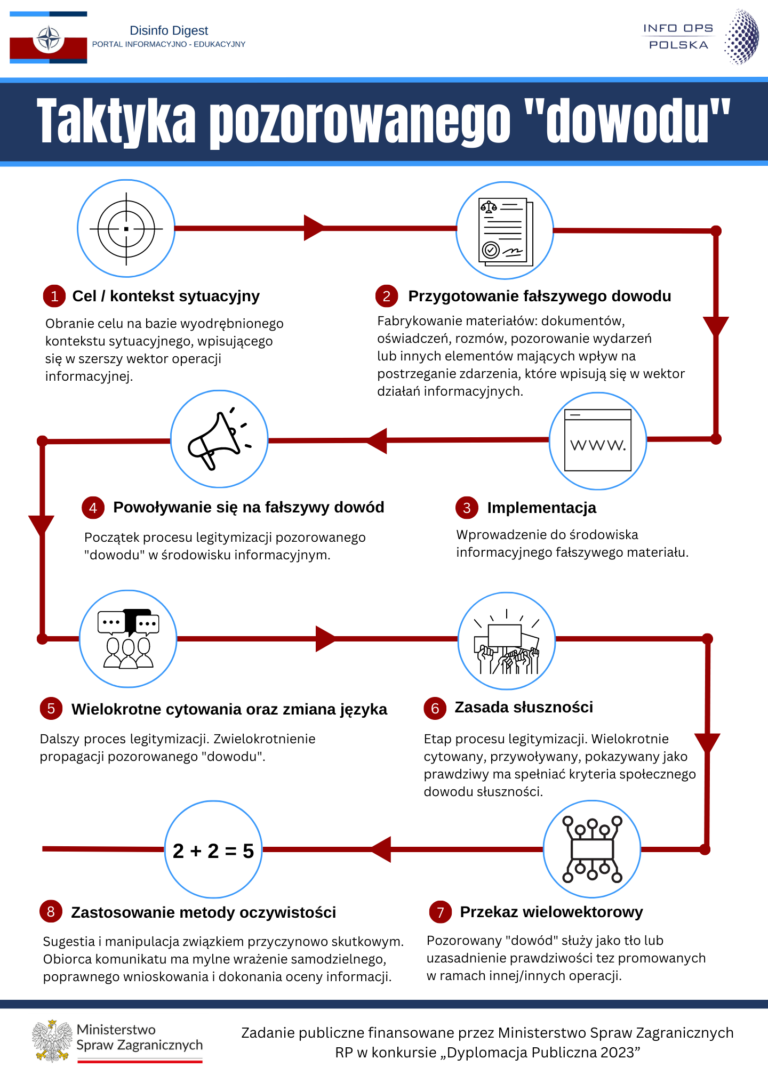
Disinformation: The Staged Evidence Tactic
It is worth noting that claims about “bot floods,” “fake accounts,” and “Russian propaganda” passed through Brzózka’s text without verification or challenge. After all, there are procedures at CERT, NASK, the Internal Security Agency, as well as appropriate procedures on social media platforms for reporting such incidents. The editorial team has obtained a response. NASK stated:
“In the period 01.01.2024–01.03.2026, NASK received no reports directly relating to matters concerning the functioning of the Łódź City Hall, nor the city’s leaders themselves. Furthermore, no analyses were undertaken focusing on the issue of disinformation activity concerning the City Hall and projects conducted or supported by said office.”
Local government, as a public entity, is subject to the Act on the National Cybersecurity System (Journal of Laws 2018, item 1560), which imposes a formal, identifiable obligation to report incidents to the appropriate CSIRT. Anonymous mode does not apply here. The absence of a procedural trail is therefore unambiguous.
The question remains about the function of this argument in public debate. If the claims about bots and Russian propaganda are not backed by any institutional proceedings — what was their role? And is Mayor Zdanowska ready to take responsibility for words that entered the public sphere as fact?
Zdanowska’s statements about organized bot campaigns and Russian propaganda are claims about information operations that should leave a procedural trail. If the communications infrastructure of Poland’s third-largest city has become the target of an organized disinformation operation, it is reasonable to ask whether any documentation supports these claims.
Did the Łódź City Hall report incidents related to “bot floods” and “Russian propaganda” to CERT Poland? Does the city possess a technical report confirming the thesis of organized inauthentic campaigns? What amounts from the city budget or municipal company budgets were spent on moderation and promotion of the mayor’s social media posts in the last quarter? We are unlikely to obtain an answer to this last question, since promotion has been shifted to the Łódź Tourist Organization Association, beyond public oversight.
The answers to these questions are verifiable — and the prosecution should be pursuing them.
Desensitization to Criticism
Brzózka’s article appears at a precise moment. The District Prosecutor’s Office in Łódź is conducting proceedings concerning the city’s and its companies’ ties to the ŁOT association. Regulatory bodies are conducting proceedings regarding digital infrastructure under municipal management. Additional formal complaints are in preparation.
None of these threads appear in the article.
Mayor Zdanowska’s communication operation is a textbook example of well-poisoning combined with projection and role reversal. Its effectiveness does not depend on the ill will of the journalist who describes it — this brilliant framing works precisely because it is ready before anyone sits down to write. It is also worth noting that many urban activists operate within the framework established by this strategy, using unsupported labels like “mafia” without evidence.
The well is poisoned before anyone has started drinking from it. And most importantly, this happens alongside a synchronized campaign of explanation that the current city strategy, flawed as it may be, is the only one possible for this underfunded Łódź — and therefore the criticized micro-apartments and tower blocks in the new city center represent the peak of what’s achievable. When you put it all together, there really is no option but to accept the city hall’s narrative and treat all criticism as hate or the arguments of detached fantasists.
Pacifying City Hall Critics and Activists
However, the frame of the “besieged city” does not appear in a vacuum. It suffices to trace the last three months. It is preceded by a series of communication crises for the city administration: the project for an exotic jungle at a cost of 380 million PLN in the Botanical Garden, a “complete neighborhood” in the New City Center — a label challenged by urban planning specialists — the deaths of four municipal housing tenants from hypothermia in winter 2026, and the suspended construction of the cross-city rail tunnel. Each of these cases generated substantive criticism based on specifics: cost analyses, environmental assessments, technical documentation.
The city administration’s response to this criticism is consistent and recognizable. Complex problems are flattened to the level of emotions. Those emotions are managed within the silo of Facebook, where those with the biggest budgets dominate. The Audioriver case demonstrated the mechanism in action: at a meeting with residents organized by the Łódź Culture Center, a city councilwoman employed by the Zoo appeared — an institution whose supervisory board vice-chair is the director of the City Hall’s Promotion Office — along with a DJ paid by the festival, both without disclosing their identities. The protest that gathered 14,000 signatures and forced the city administration to reverse its decision went down in history as an example of effective civic pressure. The Mayor apologized to Piotr Orlicz-Rabiega (co-owner of the Audioriver brand) for the bad residents who protested, completely ignoring the fact that the administrative decision designating Park na Zdrowiu had been issued in violation of the local zoning plan.
This is the core of the mechanism. Bad residents — those who protest. An activist filing freedom-of-information requests and documenting flawed acoustic assessments and the author of insults under a Valentine’s Day post occupy the same semantic space within this frame. Both are part of the attack on the city “from every direction.” A critic of municipal infrastructure becomes someone who is “attacking Łódź.” The complexity of the problem is replaced by a simple opposition: we defend the city, they attack.
Simplifying difficult issues and extracting extreme views ridicules critics before they have a chance to present an argument. This is more effective than any formal pacification.
Fortress Łódź under siege — will the walls hold?
Signal Dadalo Media has obtained a response from NASK-PIB. The institution recorded no reports concerning disinformation campaigns targeting the Łódź City Hall or the city’s mayor between 2024–2026. The full text of the response has been included in the article.
Questions to the Łódź City Hall (19.03.2026)
Signal Dadalo Media submitted an official inquiry under Article 8 of the Press Law and Article 22(1) in conjunction with Article 3(8) of the Act of 5 July 2018 on the National Cybersecurity System (Journal of Laws 2018, item 1560):
- Has the Łódź City Hall reported to CSIRT GOV, CERT Poland, or NASK any incidents related to the campaigns described in Mayor Zdanowska’s statements? If so — to which institution, when, and under what case number?
- Does the Łódź City Hall or affiliated entities possess technical documentation confirming the thesis of organized inauthentic campaigns? If so, we request its disclosure under the freedom of information procedure.
- Has the City Hall or entities acting on its behalf conducted monitoring of anomalies in social media post reach? If so, we request disclosure of the results.
- We request identification of the entities managing the city’s social media and disclosure of any correspondence with META regarding reported incidents.