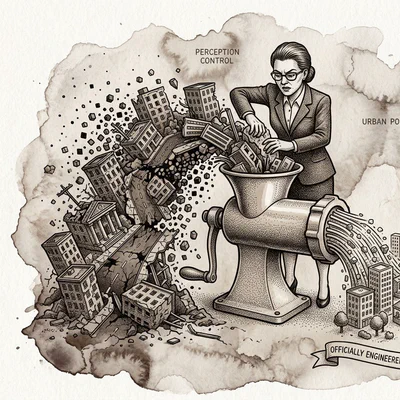
Why do millions from municipal companies flow through ŁOT? It's not about the amounts, it's about the architecture of law circumvention.
Table of Contents
Are we seeing a breakthrough in the deconstruction of the media system and the creation of internet gateways in Łódź? A vehicle for government-controlled bulletins, currently being investigated by organizations like Watchdog Poland? In my opinion, something has finally shifted…
In the article The Double Role of the President. We Reveal the Secrets of the Million-Zloty Payment from a Municipal Company to ŁOT, the editorial team of the Łódź Wyborcza reveals the inner workings of a system I have been describing for over a year. To understand why millions flow through ŁOT, one must look at the architecture of law circumvention, not just the amounts themselves. I described this from a technical perspective, but I signaled the cash flow issues back then, as top SEO and ADS specialists involve massive amounts of money and budgets.
A Vehicle Without Brakes
It is likely that the Łódź Tourism Organization (ŁOT) functions as a safety buffer for decision-makers. While municipal companies are subject to the rigors of Public Procurement Law (transparency, competition, risk of loss, audits, protests), the association allows for spending public money entirely outside this order.
The mechanism is simple, almost elegant: funds leave a communal company as a “membership fee,” enter ŁOT as the association’s own income, and from that moment on, ŁOT disposes of them according to its own internal procedures. No tender, no competitive bidding, no public finance discipline. The “fee” changes the legal nature of the transfer. This is not an inaccuracy; it is a feature of the system. Perfect optimization.
Fees are the price for access to this mechanism. ŁOT collects them from 144 entities, a significant portion of which is public money, but formally this is not “funding from public resources” within the meaning of Public Procurement Law. And this is where the legal magic happens. But this is only one element; it would be worth checking where the advertising money goes and how agreements with influencers—who benefit from the reputation of lodz.pl profiles and the portal lodz.pl as well as the entire media campaign—are bartered. This is an interesting element ready for deconstruction.
Precisely Hit Competency Threshold
I wrote over a year ago: follow the money… The amount of 999,000 PLN is a textbook example of managing a competency threshold. The supervisory board rejected a request for 1.5 million PLN; President Goss spent exactly as much as he could independently, without any approval. This was no accident. The amount was precisely chosen to stay within his authority. But this is not even about elegant spending; the more interesting part is the magic of turning public money into something managed by the ŁOT vehicle.
A Protocol That Changes Legal Qualification
It seems that the key evidence in this case will be the protocol from the supervisory board meeting. Councilor Berger asked the president of ŁOT, Koralewski, two precise questions: is what he sent an offer for a marketing service… yes. Is the company supposed to pay for this service in the form of a fee… yes. And here it gets interesting.
These answers change everything. If a fee has a pre-determined service purpose, it ceases to be a fee and becomes a purchase of a service with the intentional circumvention of Public Procurement Law. The supervisory board protocol is likely the most valuable document in the entire case.
A Financial Vehicle and an Advertising Combine
This financial vehicle does not operate in a vacuum. It works in tandem with the advertising mechanism that I described in detail in May 2025, where an analysis of the lodz.pl portal revealed a sophisticated architecture of tracking and monetization, far exceeding the information function of a city service. I also drew attention to hate algorithm mechanisms and contacted privacy advocates to monitor synchronous attacks and the triggering of bots to boost specific narratives. I also warned activists on Facebook that there is a significant disparity in the ability to manipulate the algorithm, making them mere decorations, or even “whipping boys.”
The role of Łódź Media Group, the advertising arm of ŁOT, is crucial. It operates using data from the Lodz.pl service (1 million visits/month), FB profiles, the Łódź Citizen Card (350,000 participants: age, gender, location, family structure), and the Łódź.pl app (84,000 active users with full targeting). Residents’ data is treated as a commercial product. ŁOT profits from data collected by public institutions. Because ŁOT does not have to announce tenders, it can freely choose influencers, ADS agencies, and content subcontractors. These are ideal conditions for building a network of gratitude: barters, tied transactions, “service” contracts paid without any competitive bidding. Whoever gets the contract doesn’t bite the hand that feeds. How many of these flows are visible to the public? As much as ŁOT decides to reveal, because public finance discipline does not apply to it.
It is necessary to explain exactly what happens to the advertising money in Łódź Media Group services, what the ADS service contracts look like, what the tied transactions with influencers are, and where the barters are. These are not rhetorical questions; these are transparency gaps waiting for an audit. It is also worth analyzing the segments and companies with which cooperation is established, because if developer investments are being promoted, it is likely possible to efficiently shift money by selling ADS space and settling efficiency… and here is the key question: how are the contracts structured, and does an agency handle the entire budget? If so, it is possible to very efficiently process amounts for various other things (e.g., black hat SEO).
Bots, Narrative, and Systemic Risk
The lack of control over ŁOT’s spending makes it impossible to verify whether funds are fueling so-called troll farms or astroturfing systems. Mechanisms triggering the hate algorithm—coordinated bots boosting narratives on social media—are expensive and require funding. At the current level of opaqueness in the Łódź media ecosystem, there is no mechanism that would allow this to be ruled out. This is not an accusation; it is a description of systemic risk resulting from a lack of social control.
UODO and a Coincidence That Cannot Be Ignored
My notification to the Personal Data Protection Office (UODO) from November 2025, based on a deconstruction analysis of GTM containers and covering 9 allegations regarding the intentional injection of commercial remarketing tags into public administration services (including mpu.lodz.pl), is currently being processed.
The timing between the PUODO declaration and my notification is striking and suggests that the technical analysis of GTM containers provided the authority with the necessary evidence to take action. The BIP audit announced by PUODO a few days ago could be the first step toward dismantling this pathology.
I will dedicate a separate article to the details of the notification in the coming days.
The prosecutor’s office is rightly looking at the tenders, but those organized by other entities, such as the City Library or the Łódź Events Center, which were cancelled or manipulated so that the contract would go specifically to ŁOT. But the heart of the problem lies higher, in the architecture of a conflict of interest, not in individual transactions. The possibility of hiding budgets through contract structures where ADS income and costs are handled by an external agency makes an external audit de facto impossible without access to those contracts. In my opinion, this can be decompiled.
Follow the money.