When sloppy code meets a lack of journalistic ethics, truth and the reputations of innocent people fall victim. An analysis of the case of attorney Daria Adamus, whose image was unlawfully linked to drug charges due to SEO errors and editorial laziness.
Table of Contents
One Wrong Photo. Mephedrone. And a Lawyer Who Has Nothing to Do With It.
The case of the “coffin attorney” is a self-propelling topic in the Polish internet that hasn’t left the headlines for months. However, what has transpired in recent days goes beyond the bounds of a typical celebrity scandal. The media, feeding on information about drug charges against the lawyer’s wife, entered a mode of total thoughtlessness. The result? Through a combination of sloppy programming and editorial laziness, a completely unrelated person became the face of the mephedrone scandal. Today, we analyze this pathological chain of events: from the leaky architecture of online directories to the collapse of ethics in newsrooms that, in the pursuit of clicks, forgot about basic source verification.
Let’s start by finding the name of the coffin attorney’s wife. Google’s AI overview mode helps us here, serving up personal data with its characteristic disregard for legal and social context faster than GDPR lawyers can open their laptops.
Entering the phrase “Coffin lawyer wife’s name” returns (every AI overview iteration will be different; mine looked like this):
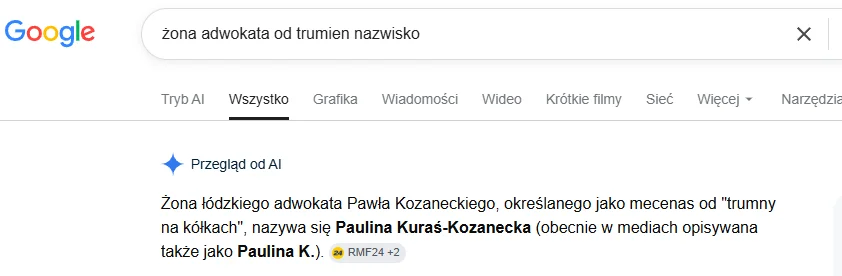
“The wife of the Łódź attorney Paweł Kozanecki, referred to as the ‘coffin on wheels’ lawyer, is named Paulina Kuraś-Kozanecka (currently also described in the media as Paulina K.).” I think additional comments are unnecessary.
However, more interesting things are happening in the images indexed by Google. In the search results, we see a photo captioned as Paulina Kuraś-Kozanecka, and the same can be seen in the Google Images tab. The problem is that the person in the photo is attorney Daria Adamus, and the effect of such indexing is the shoddy work of the developer of the skuteczny-adwokat.pl (effective-lawyer) service, who has no clue about indexing algorithms. And due to the lack of proper declarations, Google bots randomly pick images for the name.
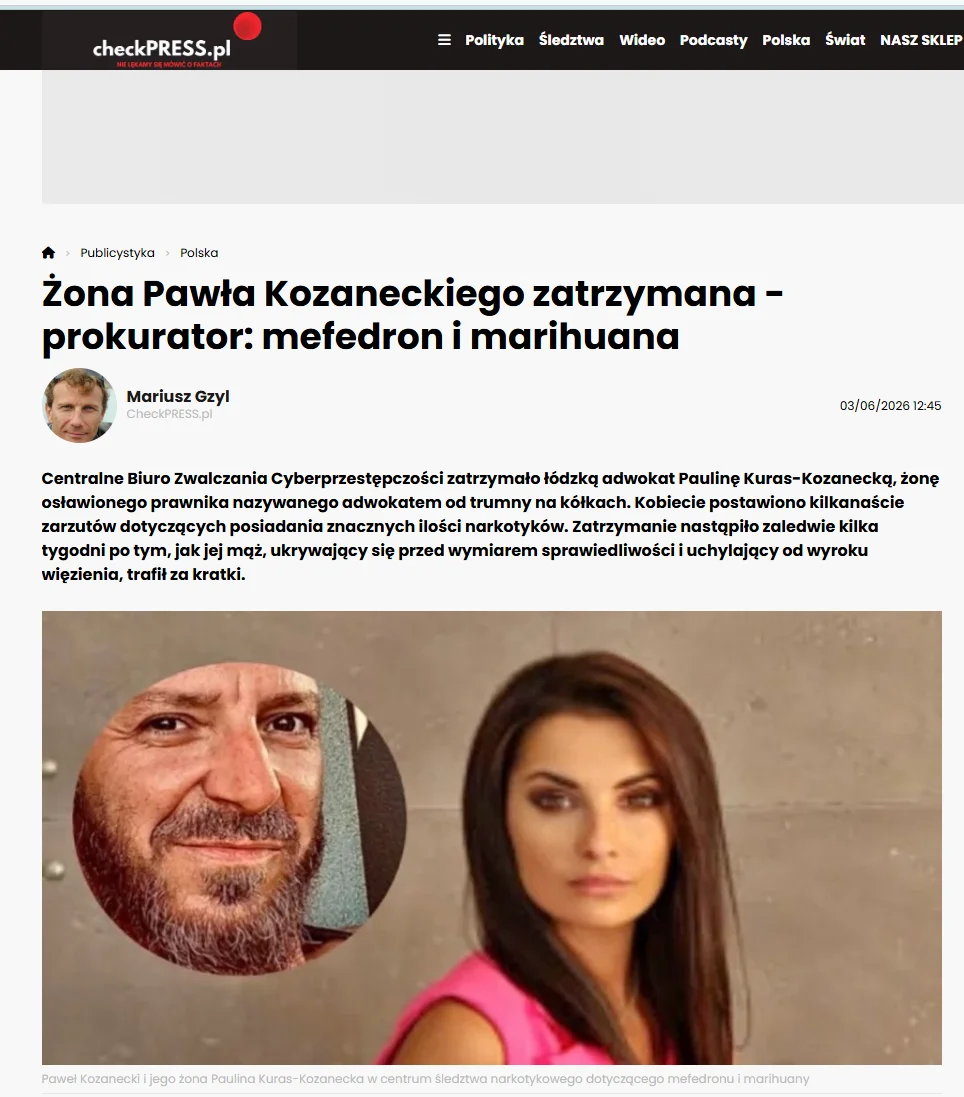
But there is a sequel to this not-so-funny story. Mariusz Gzyl, the author of the article Paweł Kozanecki’s wife detained - prosecutor: mephedrone and marijuana, fell victim to cognitive bias and total ignorance. It was all accompanied by the stolen photo of attorney Adamus, which editor Gzyl placed as the main illustration of the article, captioning it as the wife of the infamous lawyer.
I spoke with Ms. Adamus before the entire internet started escalating the matter, and later with her husband; they are currently taking appropriate legal steps to clear her reputation.
Thus, in the publication by the checkPRESS.pl portal on June 3, 2026, regarding the detention of Paulina Kuraś-Kozanecka, the image of another person, attorney Daria Adamus, was unlawfully used. This phenomenon is not the result of a single mistake but of overlapping errors: gaps in the information architecture of the skuteczny-adwokat.pl service and gross negligence at the source verification level in the editorial process. I would call it “garbage journalism,” as we are currently facing a plague of this phenomenon.
Error Vector: Information Architecture and Resource Cross-Contamination
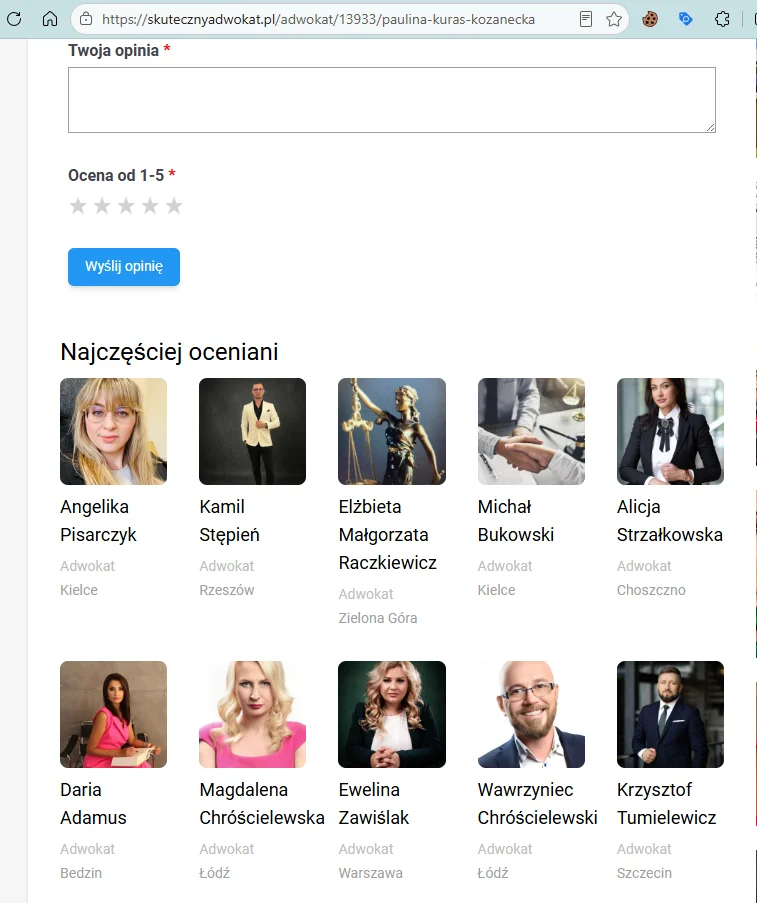
The primary source of the problem is how the skuteczny-adwokat.pl service manages visual context within the DOM (Document Object Model). On the subpage assigned to a specific lawyer (in this case, Paulina Kuraś-Kozanecka), a dynamic “Most Rated” module is implemented.
This module loads thumbnails of other lawyers within the same URL structure. The Google crawler, scanning the destination page, associates the image resources found there with the main entity described by the metadata—the name of the profile owner. The proof of the structure generating this error is shown below.
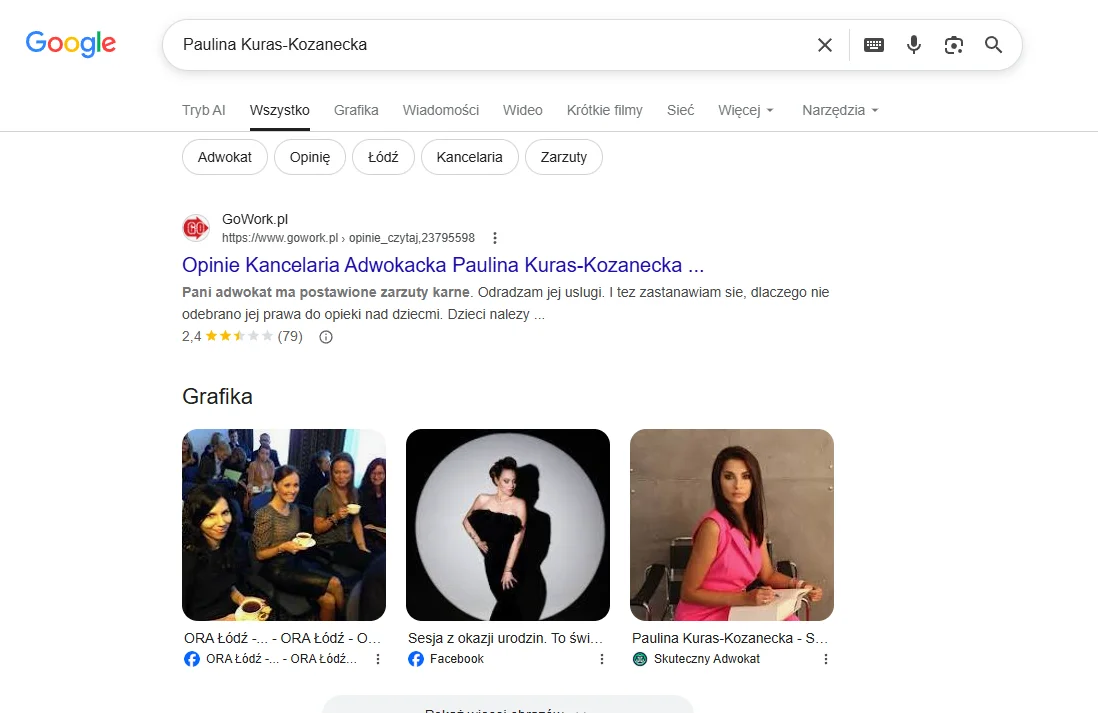
As a result of the incorrect resource separation, attorney Daria Adamus’s image was indexed in Google Images in the context of another person’s profile. This state is reflected in the comparison of image search results.
Paulina Kuraś-Kozanecka’s profile has a generic placeholder—profile_female.png—as its og:image. There is no assigned photo in the meta declarations. However, the service exposes Kozanecka’s phone number and email address in plain text in the structured data (JSON-LD), making personal data available to machines without any protection. This is a separate GDPR issue, but a telling context for a service that figures in its own description as a tool for promoting lawyers.
| |
According to information provided to me directly by attorney Adamus, the problem of faulty indexing of lawyers’ images from this service had been signaled before.
Execution Error: Lack of Source Verification
The availability of manipulated context in the search engine does not exempt the publisher from the obligation of verification. The author of the article, relying on the Google Images index, succumbed to a cognitive shortcut (confirmation bias). The verification process ended at the thumbnail preview stage, without proceeding to the source page to confirm the identity of the person in the photo.
Ignoring this basic procedure resulted in the publication of material in which the likeness of an unrelated lawyer from Będzin was juxtaposed with prosecutorial charges regarding the possession of mephedrone. It’s worth noting that a basic text query verification in Google generates correct AI summaries regarding the identity of the detainee, which indicates that the editor based his craft solely on trust in visual results.
The photo was swapped about four hours after publication, following interventions by the Adamus couple. However, the checkPRESS.pl editorial office did not publish any press correction. Swapping the photo does not remove the error from the Google index, does not reverse the reputational damage, and does not exempt the publisher from responsibility for the original publication, which remains archived.
Legal Implications and Systemic Responsibility
From an infrastructural and legal perspective, we are dealing with two violations:
Directory Administrator’s Responsibility: The skuteczny-adwokat.pl service acts as the personal data controller (image constitutes personal data within the meaning of Art. 4 point 1 of the GDPR). Maintaining an architecture that systematically assigns images to the wrong profiles is a direct violation of the principle of data accuracy (Art. 5 para. 1 lit. d of the GDPR). The lack of image resource isolation mechanisms is an architectural defect with serious legal consequences.
Publisher’s Responsibility: The publication of a third party’s image in the context of criminal proceedings creates direct civil liability for the violation of personal rights on the part of checkPRESS.pl, and potentially also criminal liability.
The article in its original form was archived in external systems (snapshot: https://archive.ph/ZNEXP), which permanently preserves the evidence of the violation, regardless of subsequent modifications on the publisher’s site.
Recommendations for Victims
If similar anomalies in image indexing are identified, the mitigation procedure should include:
- Sending a request for data erasure (Art. 17 GDPR) to the directory administrator.
- Filing a complaint with the President of the Personal Data Protection Office (UODO) due to the systemic nature of the violations of the data accuracy principle.
- A pre-litigation call to remove the material and publish a correction directed to publishers reproducing erroneous data. Personally, I managed to remove about 100 pages on FB with a single letter.