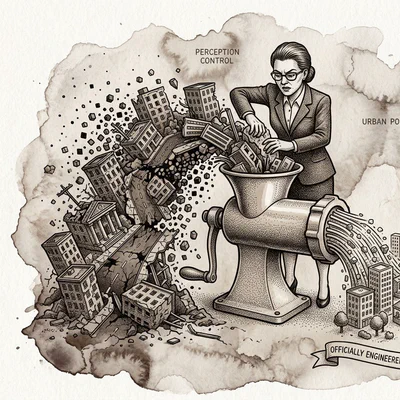
Watcher, our spatial planning monitoring system in Łódź, has undergone three months of expansion. Resident protests moved to a separate service, the procedure dashboard got a new form, and we supplemented the service with guides and analyses regarding the urban planning reform. Here's a summary of what has been done.
Table of Contents
Watcher is a non-commercial project. Since 2023, we have been developing it as part of the Signal Dadalo Media editorial team and we focus exclusively on Łódź. In July 2026, the project was supported by the Ludwika and Henryk Wujec Civic Fund in the “We Watch. We Make a Difference” competition (2026 edition). The substantive partner of the competition is the Citizens Network Watchdog Poland. The service, data, and tools are not for sale and were not created with commercialization in mind. Funding details were described in the article New stage of Watcher’s development: Funding from the Ludwika and Henryk Wujec Civic Fund.
The project responds to two problems.
The first is information asymmetry. The city hall and investors know about planned changes earlier and better than residents. Information about procedures is scattered between the Municipal Urban Planning Office website, the Public Information Bulletin (BIP), and official announcements. Sometimes it also disappears after a while. Deadlines for applications and remarks are counted in weeks from the announcement, not from the day someone found out about it. Whoever learns about the project from a local group on social media is usually already late. Watcher records every change in local plan procedures, shows at what stage a given plan is and since when it has been there, and preserves the history even when the document disappears from the city’s website.
The second problem is simulating public participation. The law gives residents specific moments of influence on the plan: applications at the beginning of the procedure and remarks on the finished draft. In practice, residents’ participation is easily reduced to a formal minimum. Deadlines at the edge of statutory minimums, meetings exclusively during working hours, or brief justifications for rejecting remarks are enough. The procedure is then formally correct, but there is little real impact. Watcher aims to make these moments visible in advance, so the course of the procedure can be later verified and compared with others.
We thank the Ludwika and Henryk Wujec Civic Fund for the opportunity to develop the project, and the mentors from the Citizens Network Watchdog Poland for their substantive support. Thanks to their feedback, Watcher is now better grounded in the standards of watchdog activities: independence, transparency, objectivity, and reliability.
July and August: two services instead of one
Until July, Watcher combined two different things. It was a monitoring system for planning procedures, but also a database of resident protests and a map of spatial conflicts. This second area grew to dozens of analyses and began to obscure the main task of the service.
We separated them into two domains. The protest database, reports, and conflict map were moved in August to protest.lodz.pl. Old links redirect to new addresses. watcher.dadalo.pl now deals exclusively with planning procedures. Both services publish content under a CC BY-NC-SA 4.0 license.
August and September: service redesign and functional improvements
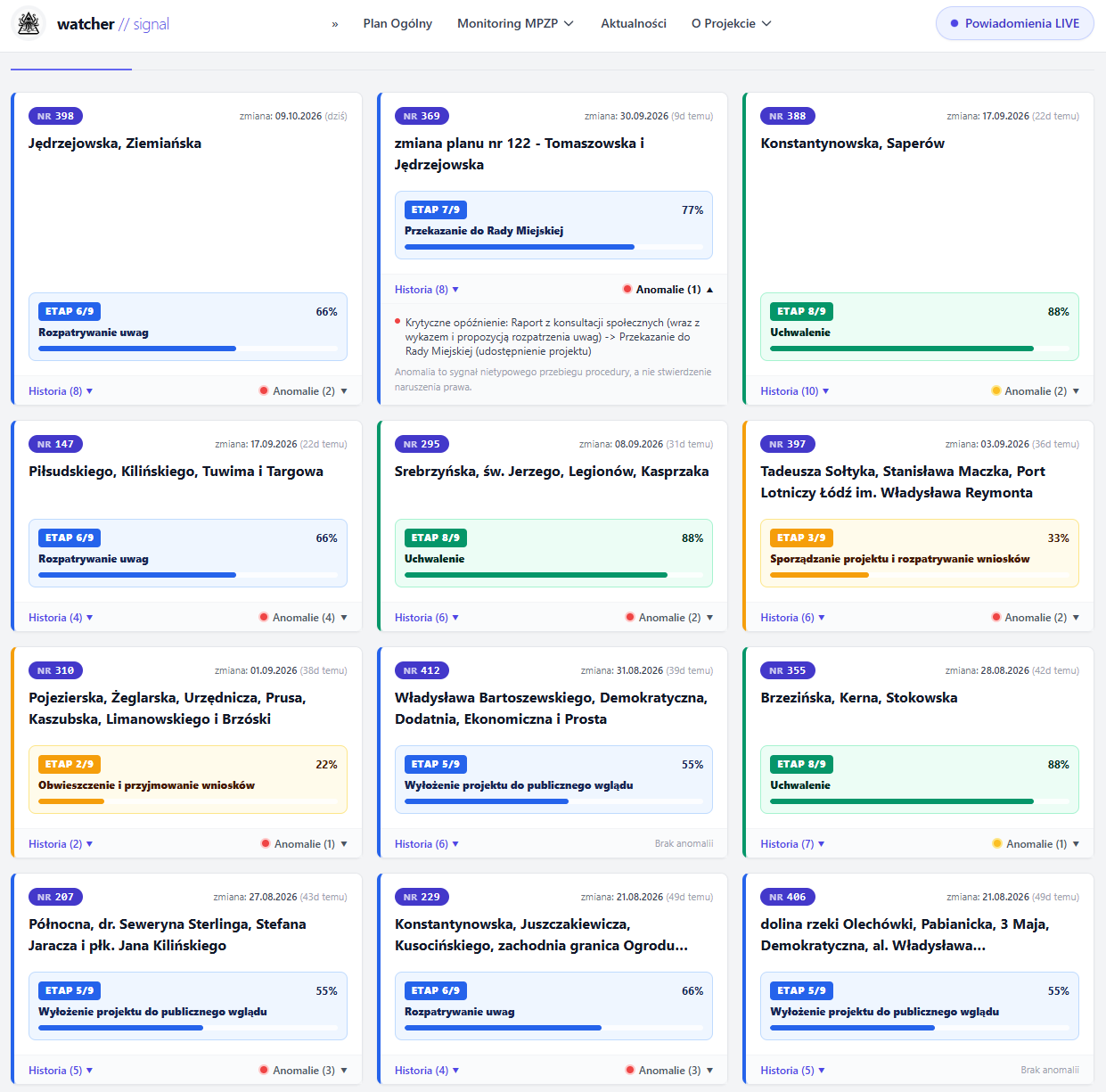
After splitting the services, we rebuilt watcher.dadalo.pl. The main page and navigation are now focused on local plans, and the service works conveniently on mobile phones.
The most important changes concern the procedure dashboard. The dashboard highlights plans that remain at one stage noticeably longer than others or regress to an earlier stage. This is a signal to investigate, not a statement of a legal violation. Plan cards are clearer and show the date of the last change. We also added an explanation of how to read this date. For procedures initiated before monitoring started, it is the date of the first recording by the system, not the date of the official act.
The notifications page now describes, without technical jargon, three ways to receive information about new procedures: via a mobile app, in a browser without registration, and through an RSS feed. We also organized our privacy policy and license terms. Content and data are open, while tool source codes remain private to prevent monitoring mechanisms from being easily blocked.
October: knowledge supplement
Monitoring procedures is of little use if residents don’t know how to use it. The urban planning reform changed almost all rules at once. In October, we supplemented the service with guides and analyses that explain the new rules in the context of the situation in Łódź.
Master Plan of the City of Łódź
A guide to the document that replaces the expired study. It describes the formal status after August 31, 2026, subsequent stages of the procedure, 13 statutory types of planning zones, urban infill areas, and municipal standards. It gathers links to the MPU map and project files made available during the opinion and consultation stage. It also advises on how to prepare for public consultations.
Stages of the Local Plan Procedure (MPZP)
Nine stages of drawing up a local plan in two variants: for plans initiated before September 24, 2023, and for plans conducted under the amended act. For each stage, we describe who decides, what the minimum deadlines are, what a resident can do, and what Watcher records.
The end of eternal “WZs”: The 5-year validity period for development condition decisions in practice
Starting January 1, 2026, the development condition decision expires after 5 years from the date it became final (Art. 64c of UPZP). However, transitional provisions keep indefinite decisions issued in proceedings initiated before October 16, 2025, in circulation. The text also describes the new framework for WZ decisions after the master plan comes into effect and the situation in Łódź after September 1.
Integrated Investment Plans (ZPI): Developers’ new weapon and a test for local government
After the expiration of the housing spec-act, the integrated investment plan became the primary tool for executing investments on an investor’s initiative. The analysis discusses the urban agreement and the participation of a council representative in negotiations. It also explains that the council can only adopt or reject the plan, without amendments, and consultations can be shortened to a 21-day period for collecting remarks. In Łódź, no ZPI can be adopted before the master plan.
Lack of a Master Plan for Łódź after September 1: Legal and urban consequences of the planning gap
The study of conditions for Łódź expired on August 31, 2026, and the master plan had not been adopted by then. The text describes the consequences. New applications for development conditions cannot conclude with a decision, new local plans generally cannot be adopted, and the ZPI mode is also blocked. We explain what stage the procedure is at and what will change once the master plan takes effect.
Want to change something in your area? Set an alert in the Urban Registry
Since October 1, 2026, the Urban Registry is the main place for publishing planning documents and sends email notifications for designated areas. The guide shows step-by-step how to set up an alert. It also lists what the registry will not show: decisions on development conditions and public purpose investment locations will only enter it starting July 1, 2029.
Nature in the master plan: how to check if your area is protected before submitting a remark
A remark on the draft master plan carries more weight when it indicates a form of nature protection and the act that established it. The guide shows how to check an area in the GDOŚ Geoserwis and the Central Register of Nature Conservation Forms, compare it with the draft master plan, and translate that into a specific remark. It also suggests what arguments to use for valuable areas not covered by any form of protection.
Plans
In the dashboard, we want to separate the date of an official act from the date it was detected by the system. This will allow us to correctly date older procedures and measure delays in publishing information. Next in line are filtering procedures by stage and district, as well as aggregate statistics on procedure durations.
In the news section, we are preparing a guide on submitting remarks to a local plan and a text on municipal urban standards. When the city mayor announces public consultations for the draft master plan, we will inform about it through Watcher’s notifications.
All current information about the Watcher project can be found at watcher.dadalo.pl/aktualnosci.
Remarks and source materials: redakcja@dadalo.pl
The initiative is supported by the Ludwika and Henryk Wujec Civic Fund
“We Watch. We Make a Difference” competition (2026 edition). Substantive partner: Citizens Network Watchdog Poland.
Project: Watcher, a civic spatial planning monitoring system in Łódź. Publisher: Signal Dadalo Media.
Text is available under the CC BY-NC-SA 4.0 license (Attribution, NonCommercial, ShareAlike).